Showing posts with label Things In A Bottle. Show all posts

Thursday, January 1, 2026

Thing in a Jar

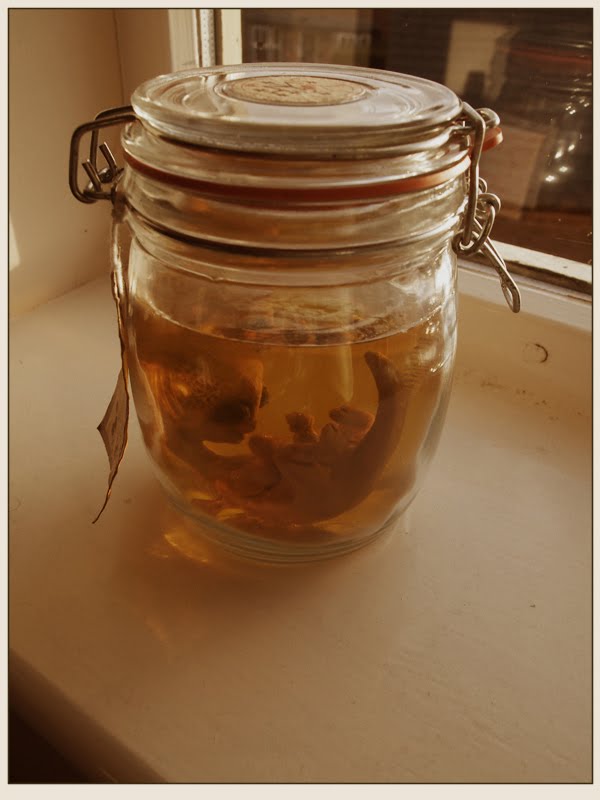
We kick off 2026 with this toothy bottled specimen from Grant Cross.  The white membrane is liquid latex that's been partially rubbed off the figure.


Monday, May 2, 2016

The Reality of Things in Jars

The talented Britta Miller is no stranger to these pages. Beyond producing some choice Mythos artifacts she also happens to work in an actual museum filled with shelves of preserved biological specimens. Ms. Miller was kind enough to share some insights based on that experience.

Thought I'd drop an email on the subject of Things In Jars, as I have been working for the past 1 1/2 years in the Holy Grail of Things In Jars, a museum specimen collection.

It's pretty glorious.


Since Things In Jars is a popular prop making project, I thought I'd share some observations from my time spent among the ghastly dead. I have yet to make any pickled things props, but perhaps anyone setting out for realistic "museum specimen" props could get some use out of it.

Most everything is stored in 70% ethanol. The primary color of alcohol with things in it for a long time is golden yellow, from dissolved fat. New alcohol is clear, but the longer something is in a jar, and the "meatier" it is, the darker yellow the alcohol ends up, even shading almost to orange with blobs of fat floating on the surface. Never green, despite how popular it is in prop making. I suppose a case could be made for alien biology, but neon green preserving fluid always looks more "sci fi B movie" than convincing. 
An aside to this is a preserving fluid not as widely used now called "Bouin's solution" which is almost neon green-yellow and stains horribly. Cracked open a jar of things in Bouin's solution without realizing that's what it was, and the stain didn't come out of my fingers for a couple days.

Aside from large gallon jars with plastic screw tops, the primary sort of storage vessel is canning jars with rubber gaskets--often the kind with the logos right on them. (also, never metal screw tops). Keeps a much better seal--and never sealed over with wax, like I see often in prop making (good for props to keep evaporation down, but in an actual specimen collection you need access to everything to add/use/study specimens, and unsealing/resealing would be a major time suck) Alternately, the collection used to be housed in glass jars with glass tops (antiques, now) before being modernized to the rubber-gasket variety.

Some interesting observations on color: Naturally, things fade after being preserved, but they fade pretty specifically. Bright colors go quick--reds and yellows end up dulled to brownish/whitish. Greys/browns/whites and patterns tend to stay visible, unless something is poorly preserved/left in the light for too long, then it'll fade almost to nothing. Green is an interesting one--due to the nature of how green coloration works, it simply doesn't exist in preserved specimens. Preserve a bright green frog or snake, and it winds up a dusty blue color, which is actually quite attractive.

In life, these are brilliant green tree frogs.


Also, tags! Tags are never stuck to the outside of jars, they'd eventually wear off/fade to nothing. They're typed--or handwritten, on the oldest specimens--in waterproof ink on regular old paper and dropped right in the jars. Even things collected in the 20s or before have their original hand-written tags in the jars, still legible. And individual specimens within the jar have their catalog numbers tied right on them. In a museum you can have a hundred of a single species in one jar. This actually was somewhat of a surprise the first time I was in the collection, my main exposure to Things In Jars previous to this having been film/displays where a single specimen is arranged nicely for display--here, jars are often packed full of dozens of individuals. It's a striking effect, in a completely different way. In the case of really tiny things, like tadpoles or larval newts, individuals tend to be stored with their catalog number in a vial, stuffed with cotton, in the main jar. 

This is probably all information readily available elsewhere on the internet, but I thought I'd share anyway.
 
I'll leave you with this lovely alligator heart in a jar.
 

Sunday, April 8, 2012

Thursday, December 22, 2011

Bottled Beasts

From "das Zny", his first bottled specimens.


I think the contamination problem is coming from the cloth identification tag. As he points out, bacterial growth inside a specimen intended for show isn't necessarily a bad thing. Creatures made from polymer clay will shrug it off, but any acrylic paints applied to the creature will eventually be destroyed.

The best way to prevent contamination is to give the jar and anything going inside a good washing with hot soapy water. Follow that up by adding a few grains of sodium metabisulfite to the preservative fluid and you'll have a sterile environment that won't support any unwanted growth. It's safe, easy to use, and you can pick it up on Amazon for pocket change. A one pound supply will be enough for a lifetime's worth of bottled specimen props.

Wednesday, August 24, 2011

Thing in a Jar

James Pocklington brings us this diminutive specimen in a jar. For safety, always make sure you bring their internal temperature up to at least 140 degrees F when you're canning humanoids.

Thursday, August 11, 2011

The Embryo

Artist Jesse Lee Lechok brings us this alien embryo, cast in latex from a clay master. The rich coloration and variable levels of translucency are quite nice.

Thursday, August 4, 2011

It Floats

Brian Demski brings us this nasty little preserved specimen . And by "nasty" I mean "awesome".

Monday, March 21, 2011

The Killian Collection

A variety of Lovecraftian specimens collected by the infamous Dr. Killian, brought to us by Jason McKittrick. The weathering is simply outstanding.

Monday, March 7, 2011

Yithian Nerve Core

Richard John Wiesen brings us this preserved Yithian nerve core made from liquid latex over a polymer clay armature.

Monday, February 28, 2011

Latex Longevity

This is a followup to Saturday's post about the effect on long term immersion on the kind of latex creatures using in "things in a bottle".

After 48 hours out of the solution the worm has dried and shrunk back to it's original size. Based on that I think it's safe to say that the swelling is caused by the latex acting like a sponge and absorbing the water, as opposed to actually reacting with anything in the solution. The latex is firm and tight, in contrast to the soft consistency it displayed right after being removed from the fluid.


After eight months of immersion there's absolutely no degradation of the latex. I have older specimens that look fine, but this is the first one I've opened up and closely examined. The only noticeable change to the body is the loss of some applied weathering to the surface. That appears to be the result of abrasion against the inside of the glass and not any kind of breakdown.


I'm still trying to figure out how the green dye from the fluid colored the epoxy resin of the teeth.

Saturday, February 26, 2011

"Thing in a Bottle" Longevity

Today I opened up a latex "specimen" that I bottled up in June of last year. Why? To test the effects of time on both the bottle seal and the critter inside.

The seal, consisting of an internal and external layer of silicone for the lid and a coating of melted wax, was in absolutely pristine condition. It took a considerable amount of force to break the wax away, so I think it's safe to say it won't flake off under normal use. The lid wasn't quite so easy. There was some minor movement when I tried to twist it off, but the seal didn't break until I cut the silicone along the entire circumference with an X-Acto blade. Once that was done the top came off with only minor resistance.

Here's the specimen right after it was decanted.


The latex is fully intact, but it has absorbed some of the fluid and swelled up. Not surprisingly, the thickest latex bits, particularly the "horns" along the body, are the ones that have grown the most. At a guess I'd say they're 30 percent larger than in their pristine state.

Outside of that the latex is in tip-top shape. The fluid was a 90/10 mixture of distilled water and glycerin with a few grains of potassium metabisulfite to sterilize the contents, so there shouldn't have been anything for the latex to react with. Without bacterial action or UV light the latex should be stable for years.

The teeth are the real surprise. They were sculpted from Apoxie Sculpt, and they've obviously absorbed the green dye used to tint the preservative fluid. That seems odd given the resistance of epoxy resin to most chemical attacks. It's not a bad effect, just not something I expected.

I'll have some more pictures tonight once the specimen has had a chance to dry.

Friday, February 25, 2011

The Guinea Naga

Julian DiMarco brings us another oddity from the Able Workshop, this time a preserved example of the "Guinea Naga".


As an aside, it's always a good idea to check the publish date for your posts. Otherwise the feature you intended to show up this morning might not pop up until you finally get around to checking the blog at night. Not that I would ever make such an error, of course. Heh.

Sunday, February 20, 2011

Werewolf Fetus

"Shadechristiwolven" brings us this preserved werewolf fetus sculpted from polymer clay over an aluminum foil armature. In the project description she mentions using Pepsi to color the fluid. I'd be interested in finding out if the acid in the cola reacted with the aluminum of the armature.

Friday, February 11, 2011

Little Sis

Artist David Presnell brings us this recreation of a traditional sideshow-style pickled punk. It's a shame the gloriously seedy curiosities that were such a big part of traveling carnivals are rarely seen today.

Wednesday, February 9, 2011

They Float

Artist "ZombieArmadillo" brings us this collection of bottled specimens created for an indy film. As they say, quantity has a quality all its own.

Friday, January 21, 2011

They Bite

Carim Nahaboo brings us these outstanding bottled specimens. The creatures were sculpted out of Fimo polymer clay and colored with an ink wash.

Wednesday, December 22, 2010

A Discovery of Earth Shattering Importance

I think I may have made a major breakthrough in the field of "Thing in a Bottle" technology. It's downright embarrassing how little discoveries like this make me giddy. Heh.

One of the reasons I don't make solid polymer clay or resin creatures is that they'll eventually break after repeatedly hitting the glass inside a bottle. I've tried to address that problem with a few experiments using a viscous cationic polymer suspension. Or, as it's more commonly known, "cheap hair gel from the dollar store". Sadly, hair gel is filled with characteristic air bubbles, so every specimen looked like a gruesome monstrosity suspended in...hair gel. Ugh.

One of the approaches I tried to get rid of the bubbles while maintaining the semi-solid consistency of the material was boiling it in a microwave. That kind of worked, producing a gel with thousands of very tiny bubbles. Still unsightly, but better than before.

This week I stumbled across the secret of removing all the bubbles from the gel- boiling it twice. Just put about a cup of the stuff inside a pyrex measuring cup or bowl that can hold at least three cups, bring it to a boil in the microwave, then stir in two drops of dish detergent and let it cool overnight. The next day, boil it again, add food coloring to tint, skim the film of bubbles off the surface, pour the gel into your container while it's still warm, and let it cool to room temperature.

Tada! You get an optically clear suspension. The creature I was using for the experiment doesn't have a paint job, but you can see it floating serenely in the jar.


I still want to fiddle around with the technique to make sure temperature or pressure changes don't cause problems, but I'm very optimistic about how useful this will be.

Sunday, December 12, 2010

Loose Meat

Home canning is a traditional bit of Americana, but artist EyeconFX demonstrates that it can have a sinister side. This might explain why the righteous gleam in the eye of locavore advocates has always made me a bit uncomfortable.

Wednesday, November 24, 2010

It Floats

Dead things don't float.

Wait, strike that. Old dead things don't float. And that's a problem if you're trying to create a convincing preserved specimen or "thing in a bottle".

Here are some examples of the real thing from the Harvard Museum of Natural History, nicked from this excellent collection on Flickr.


Here's another one- a vintage preserved jellyfish from Oxford's Museum of Natural History (taken from here).


Wonderful, aren't they? Icky, vaguely disturbing, and, like all well preserved biological specimens, they're not bobbing around like corks. Which is where the problem comes in if you're trying to reproduce a prop version. How do you keep your lovingly created bit of nastiness from floating?

Unfortunately, most of the materials that are ideal for long term display in fluid are buoyant. Worse, even materials that are denser than water, like resin and most hardened polymer clays, will float if air is trapped inside. That can really come back to bite you at the worst possible time. Like when you discover your meticulously sculpted masterpiece acts like a life preserver because of the air bubbles in the loosely packed armature of aluminum foil.

The easiest way to get around the problem is to add enough weight to your specimen that it won't float. That can create some problems of it's own, since having your critter banging around on the bottom of it's container looks just as fake as it floating. Not to mention the potential damage that banging will cause of over time.

So how do you find the balance between too heavy and too light? You cheat.

I'll use this worm as an example. I know that, in general, silicone and latex are very close to being neutrally buoyant. That can change based on how much air gets trapped in them as they set up, but a good rule of thumb is that they're just slightly buoyant. That means the body of the worm will want to float. The resin teeth, on the other hand, are heavier than water. That means the creature as a whole is top heavy and wants to flip end for end.


So how do I tweak it to keep it's buoyancy under control? I add ballast, just like in a ship. While you could use anything heavy I think glass (specifically the little decorative glass beads used for flower arranging) is the best material available. It's cheap, readily available, and totally inert. A glass rod inserted into the body of the worm during sculpting will provide more than enough weight to keep it from floating.

Then, to counteract it's now considerable negative buoyancy, I add an air bubble to the upper body. Just like a dive marker or a crabber's marker buoy, the small amount of air trapped in the upper body keeps it pointing towards the surface and acts as a damper on the creatures inertia. Conveniently, a 9/16 plastic bead has just enough air inside to balance a glass bead of equal or slightly larger size.


Admittedly, making sure fake bottled specimens don't float isn't an issue for most people. If it looks creepy, so what if it bobs around? On the other hand, being aware of how to use buoyancy to your advantage opens up some really interesting techniques. If you're crafting a tentacled monstrousity it's pretty handy to know that putting a drop of hot glue inside the tip of latex tentacles will produce a cool floating effect.

Or you could just have someone else do all the work and admire the nifty bottled specimen on your shelf. Coincidentally, the plump worm with the toothy maw, along with some of it's relatives, will be on Ebay for Black Friday. And nothing quite captures the spirit of the holidays like a bloated, flesh devouring invertebrate.

Thursday, November 11, 2010

Project Thing In A Jar

Kawfi brings us a profusely illustrated tutorial on making a "Thing In A Jar". I love the gnarly, dripping wax seal.