
Friday, October 4, 2013

Thursday, October 3, 2013
Twin Serpent Guardian
Nick Storm was kind enough to send over a link to this nifty Twin Serpent Guardian from Landron Artifacts. There's a nicely detailed making of as well.


Wednesday, October 2, 2013
The Innsmouth Tooth
This is another iteration of the "Innsmouth Tooth" project I first did back in 2009. I'm really happy with how it came out, but I wasted a huge amount of time thanks to my smug cleverness.
I wanted a more realistic depiction of an aged tooth, so I tried to think of natural materials that would lend themselves to the project and eventually settled on antler. At the time I assumed I'd just have to reshape the point of an antler tip with a Dremel tool, slap some stain on it, and call it a day. A quick and easy project that I could finish in an afternoon.
That was...overly optimistic.

First off, finding an antler tip that was actually tooth-shaped was surprisingly hard. Out of the fifteen pieces of antler I went through only one was even close to having the proper smooth curve. Most of the points were actually blade shaped in profile, not round. The one that did have the right shape had a very blunt end that needed to be honed down to a proper point. That's when I encountered the second problem- antler is hard.
There's a reason our ancestors used this stuff for tools. If it's been sitting in the sun for a few months it can get soft and chalky, but antler that's protected from light and weather is amazingly tough stuff. That quick little sanding job to give it a point ended up taking close to an hour with a Dremel equipped with a sanding drum. A cutoff wheel made quick work of the broken root end. Oh, one other thing. Make sure you're wearing a respirator or at least a tight dust mask if you're working antler. The process stinks to high heaven and the resulting powder is terrible for your lungs and breathing passages.
So after all that it was time to apply the stain and glory in the beautiful natural textures of my faux tooth. That's when I discovered antler isn't absorbent and it will only take surface color, not penetrating stain. It looked like a brown lump of wood with no notable surface texture at all.
This is when I realized that using antler was a stupid idea, because I now had to go back and do everything I would have done to a "tooth" made from Sculpey to get a decent result. That meant sanding down the entire thing to give it some surface bite to take paint, and scraping down the root end with a wire brush to get those nice age cracks.
Did I mention that antler is hard? What would have taken a few minutes with a baked Sculpey tooth ended up taking another hour. But by this time I hated the thing so much that I was hell-bent on salvaging something out of the whole misbegotten effort. Once the texturing was done I gave the whole thing a light wash of black acrylic paint followed by walnut brown and burnt umber along the base. A light sanding brought out the white of the tip.
After all that it still didn't have the sheen of tooth enamel, so I ended up burnishing the whole thing with a steel rod- exactly what I would have done with a Sculpey tooth. Except a tooth made out of Sculpey would have been done in an hour or two, while this thing ended up taking an entire day.


Ultimately, it came out looking really good, but the effort required to use real antler was all out of proportion to the results.
Tuesday, October 1, 2013
Mad Science
Sinister Rouge FX brings us some classic mad science. This is their con display, and it features some great preserved specimens.


Monday, September 30, 2013
The Eye of Azathoth
The prolific Jason McKittrick brings us The Eye of Azathoth, a Mythos-themed ouija board. It's a limited run piece that will only be available for a week.


Sunday, September 29, 2013
Easy Eyes
Well, relatively easy. Sytnathotep has a tutorial on using epoxy and photo prints to produce some very nice eyes. The results are near taxidermy eyes in quality, but for just pennies apiece.


Saturday, September 28, 2013
Relics
The history of exhibition gaffs, defined narrowly as fake or manufactured creatures and body parts intended for viewing by the public, stretches back thousands of years. For most of that time they were primarily religious in nature, serving as fixed or traveling examples of spiritual or mythological belief made real. What's really interesting is that the phenomenon crosses cultural boundaries. No matter what the belief system or era you'll find all sorts of ginned up "artifacts" associated with it, from the mummified kappas of Japan to the West's long tradition of collecting the body parts of Christian saints.
The desire to see a bit of the divine may have waned, but it's still around. Hence the existence of a site like For All the Saints, a ministry that specializes in making Catholic relics available to churches for special occasions. Browsing through it's collection gives you a fascinating look inside a cultural niche that draws on thousands of years of history while being surprisingly technologically aware. I mean no disrespect, but YOU CAN ORDER A PIECE OF ONE OF GOD'S CHOSEN OVER THE INTERNET. That's absolutely amazing.
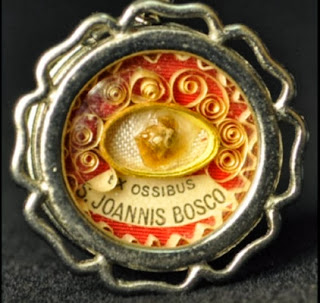
From a propmaking perspective, there's a lot of really interesting stuff here. Catholic relics have been a huge influence on gaff displays in the West, with very specific iconography like rayed circles and sealed mounts becoming secularized over the years. Just look at this presentation of a bone chip from St. Anthony of Padua. Even non-Catholics would immediately recognize it's something precious and highly valued thanks to the ornate stand for the theca, the small sealed case that contains the actual relic.

The ritual around the authentication of relics is pretty interesting in itself.

As usual, the guidelines for spotting fakes are where propmakers will find some of the most useful material. Props are by nature counterfeits, so experts trained to spot them are the best resource for everything from how to make a realistic wax seal to duplicating Vatican documents.
I know some of you are probably asking yourselves "Why is he featuring this?" Two reasons. One, relics are an important part of the history of gaffmaking. Two, a site like this is a goldmine if you're willing to use it. I'm thinking particularly of vampire hunting kits. Almost every existing example is a Blomberg-style kit, which I'd argue is decidedly Protestant, if not Calvinist, in it's presentation. They're workman-like collections of tools almost totally devoid of ornamentation, designed to physically combat the menace of vampirism without any consideration of fighting it's spiritual taint.
It's not hard to explain why they have that aesthetic. The most obvious reason is that the originals were put together by British antique dealers based on celluloid examples created by British propmakers for the Hammer vampire films. Both groups had limited cultural exposure to Catholicism, not to mention a notable dearth of Catholic items to draw on. Ironic that, given the explicitly Catholic Abraham Van Helsing from Stoker's "Dracula".
Oddly enough, the Catholic church and it's approach to vampire killing has been a far more prominent in literature. I'm not sure why propmakers have been reticent to draw on that body of material, other than the fact that there are vanishingly few visual references. One interesting example is John Steakley's "Vampire$", which featured all kinds of Catholic goodness, like Vatican vampire hunting warrants, customized and blessed stakes for self-destruction in case of infection, and specialized rituals. Something that was totally dropped from John Carpenter's rather dodgy film adaptation.
I'd love to see someone tackle a "Catholic" vampire hunting kit, filled with all kinds of ritual items and documents drawing on the church's long history. The aforementioned warrant would be cool to see, as well as sanctified weapons, specialized gear for emplacing seals in and around structures, spriitual "decontamination" kits for treating infection...the possibilities are endless.
The desire to see a bit of the divine may have waned, but it's still around. Hence the existence of a site like For All the Saints, a ministry that specializes in making Catholic relics available to churches for special occasions. Browsing through it's collection gives you a fascinating look inside a cultural niche that draws on thousands of years of history while being surprisingly technologically aware. I mean no disrespect, but YOU CAN ORDER A PIECE OF ONE OF GOD'S CHOSEN OVER THE INTERNET. That's absolutely amazing.
From a propmaking perspective, there's a lot of really interesting stuff here. Catholic relics have been a huge influence on gaff displays in the West, with very specific iconography like rayed circles and sealed mounts becoming secularized over the years. Just look at this presentation of a bone chip from St. Anthony of Padua. Even non-Catholics would immediately recognize it's something precious and highly valued thanks to the ornate stand for the theca, the small sealed case that contains the actual relic.

The ritual around the authentication of relics is pretty interesting in itself.
Any bishop or leader of a religious order may produce relics. The small piece of relic material is usually enclosed in a locket-like container called a theca which has frequently been highly decorated by nuns. The relic is tied into the theca with red thread and then sealed with red wax. While the wax is still soft it is imprinted with the seal of office of the person authorizng the preparation of the relic.
Starting in the Middle Ages many abuses grew out of an illicit trade in relics, many of which were counterfeits. The Church declared that any relic that would be used for public veneration must be accompanied by a document of authenticity. The document describes the relic and is signed by the authorizing official or his representative. Below are a couple examples of these "authentics."


As usual, the guidelines for spotting fakes are where propmakers will find some of the most useful material. Props are by nature counterfeits, so experts trained to spot them are the best resource for everything from how to make a realistic wax seal to duplicating Vatican documents.
I know some of you are probably asking yourselves "Why is he featuring this?" Two reasons. One, relics are an important part of the history of gaffmaking. Two, a site like this is a goldmine if you're willing to use it. I'm thinking particularly of vampire hunting kits. Almost every existing example is a Blomberg-style kit, which I'd argue is decidedly Protestant, if not Calvinist, in it's presentation. They're workman-like collections of tools almost totally devoid of ornamentation, designed to physically combat the menace of vampirism without any consideration of fighting it's spiritual taint.
It's not hard to explain why they have that aesthetic. The most obvious reason is that the originals were put together by British antique dealers based on celluloid examples created by British propmakers for the Hammer vampire films. Both groups had limited cultural exposure to Catholicism, not to mention a notable dearth of Catholic items to draw on. Ironic that, given the explicitly Catholic Abraham Van Helsing from Stoker's "Dracula".
Oddly enough, the Catholic church and it's approach to vampire killing has been a far more prominent in literature. I'm not sure why propmakers have been reticent to draw on that body of material, other than the fact that there are vanishingly few visual references. One interesting example is John Steakley's "Vampire$", which featured all kinds of Catholic goodness, like Vatican vampire hunting warrants, customized and blessed stakes for self-destruction in case of infection, and specialized rituals. Something that was totally dropped from John Carpenter's rather dodgy film adaptation.
I'd love to see someone tackle a "Catholic" vampire hunting kit, filled with all kinds of ritual items and documents drawing on the church's long history. The aforementioned warrant would be cool to see, as well as sanctified weapons, specialized gear for emplacing seals in and around structures, spriitual "decontamination" kits for treating infection...the possibilities are endless.
Subscribe to:
Posts (Atom)